
My mother was handed the wrong baby at the hospital. Which, as family histories go, is a fairly compelling reason to question your ancestry.
When my oldest sister was born, my mother was still recovering from anesthesia. My father had already seen their daughter, a beautiful baby with dark hair and olive skin. Imagine Mom's surprise when a nurse appeared carrying a pale redhead.
"This isn't my baby," she said.
"Mrs. Sutherland, I assure you, this is your daughter."
"No, it isn't."
She was right. The hospital had mixed up the newborns.
Five years later, I arrived blonde, blue-eyed, and apparently carrying every recessive gene available. I like to imagine Mom taking one look at me and saying, "Not again."
And Dad, having learned something from the first experience, replying, "Yep, this one actually is yours."
My sisters weren't convinced. They insisted I was the milkman's baby, although that would've required the milkman to look exactly like my mother. I was her carbon copy, right down to the expression she wore when somebody was getting on her nerves.
Dad looked like Elvis Presley: tall, dark-haired, olive-skinned, with blue eyes. Mom was petite, blonde, and brown-eyed. My sisters inherited his coloring and grew to more than five feet ten. I barely reached five feet four and could develop a sunburn while reading about the beach.
We were the three Sutherland girls, although I occasionally felt like somebody had included the neighbor's child.
Strangers would stop Mom to admire her beautiful daughters, gush over my sisters, then pat me on the head.
"And you're so cute, Sonny."
Apparently, I was the participation trophy in a family of beauty queens.
Mom always reassured me, "Your beauty is on the inside."
Wonderful. My sisters got the looks, and I got an internal organ nobody could see.
My younger sister was only eighteen months behind me. We dressed alike, styled our hair the same, and were mistaken for twins for nearly a decade. She was painfully shy, while I was the one confronting her bullies and making certain she got safely to the carpool line. I took being her older sister seriously, whether she needed my supervision or not.
About five years ago, we were reminiscing when she mentioned those strangers who complimented her and treated me like an afterthought.
"You know, that really bothered me," she said. "I remember how painful it was to hear. I can't imagine what it felt like to be you."
What surprised me wasn't that she remembered. It was that she'd understood, even as a child, what the adults hadn't considered.
They thought they were being kind. She understood that a compliment could hurt someone who wasn't receiving it.
Those little remarks had influenced how I saw myself for years, although eventually I became much better at criticizing my appearance than anybody else.
After my divorce, I moved temporarily back to my hometown with my boys and occasionally joined Mom and her friends for dinner. They'd tell me how beautiful I was, then recount something thoughtful I'd done or a kindness they remembered.
I'd make my usual joke about my beauty being on the inside.
What I eventually realized was that Mom had been telling them those stories for years. While I thought she was offering consolation, she'd been bragging about her daughter.
I had mistaken her pride for pity.
Now, approaching sixty, I still love beautiful clothes, makeup, and flattering lighting. I see wrinkles, too. Gravity and I have reached the stage of our relationship where we're staying together strictly for practical reasons.
Yet the woman looking back at me has raised two boys, survived a divorce, made some spectacular mistakes, and lived a life I wouldn't trade for anybody else's.
I get criticized on this app regularly, often by people who seem to have mistaken Instagram for a public service dedicated to correcting other women's shortcomings. I can't imagine spending my afternoon that way, but apparently everybody needs a hobby.
The difference is that their opinions no longer get to accompany me home.
The people I love know my character, my humor, my faults, and what I'll do for them when life gets difficult. They couldn't care less whether I've gained a few pounds or left the house without concealer.
Pretty doesn't fill a church at your funeral. The way you loved people does.
Nobody comes to a memorial service to discuss a woman's cheekbones. They come because she showed up for them, because she made them laugh when they needed it, because she remembered what mattered and made them feel that they mattered, too.
I think about my younger sister recognizing an unkindness that grown people missed. I think about my mother, whose face I inherited and whose advice I spent decades misunderstanding.
She was never asking me to settle for being less beautiful than anyone else. She was teaching me to become someone whose worth could never be settled by a stranger.
The hospital may have handed my mother the wrong baby once. But the real mistake was spending half my life believing there was something wrong with the one she brought home.
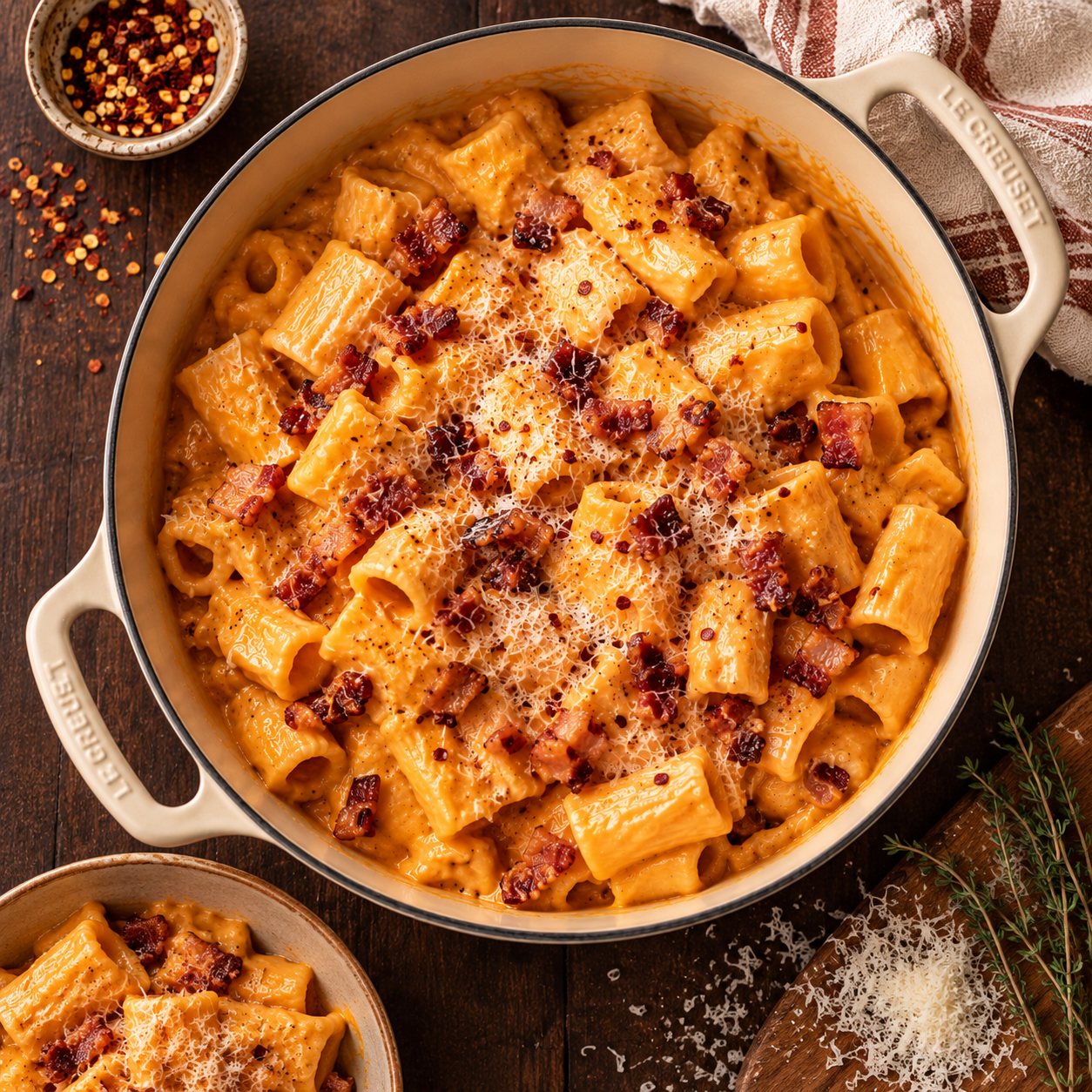
Roasted Butternut Squash Vodka Pasta with Crispy Pancetta
Serves 6
INGREDIENTS
For the Roasted Butternut Squash
- 6 cups peeled and cubed butternut squash (about 30 ounces)
- 2 tablespoons olive oil
- 1 tablespoon finely chopped fresh rosemary
- 1 tablespoon fresh thyme leaves or 1½ teaspoons dried thyme
- ¾ teaspoon kosher salt
- ½ teaspoon freshly ground black pepper
For the Pasta and Sauce
- 1 pound girelle or rigatoni pasta
- 6 ounces diced pancetta
- 2 medium shallots, finely chopped (about ½ cup)
- 6 garlic cloves, minced
- 1 teaspoon smoked paprika
- 1 teaspoon crushed red pepper flakes
- ⅓ cup vodka
- 1½ cups low-sodium chicken stock, plus up to ½ cup more as needed
- ½ cup heavy cream
- 1 cup freshly grated Parmigiano-Reggiano
- ½ teaspoon kosher salt, plus more to taste
- ½ teaspoon freshly ground black pepper, plus more to taste
- 1 cup reserved pasta cooking water, as needed
- Fresh thyme leaves, crushed red pepper flakes, crispy pancetta, and freshly grated Parmigiano-Reggiano, for serving
- Preheat the oven to 425°F. Arrange the butternut squash in a single layer on a large rimmed baking sheet. Toss with the olive oil, rosemary, thyme, salt, and black pepper. Roast for 25 to 35 minutes, turning halfway through, until completely tender and lightly golden around the edges.
- Meanwhile, cook the pancetta in a large, deep skillet over medium heat for 6 to 8 minutes, stirring occasionally, until golden and crisp. Using a slotted spoon, transfer the pancetta to a paper towel-lined plate. Reserve 2 tablespoons of rendered fat in the skillet, discarding any excess.
- Reduce the heat to medium-low. Add the shallots to the skillet and cook for 3 to 4 minutes, stirring occasionally, until softened. Add the garlic and cook for 1 to 2 minutes, stirring frequently, until fragrant but not browned.
- Stir in the smoked paprika and crushed red pepper flakes. Cook for 30 seconds, stirring constantly, to bloom the spices in the pancetta fat.
- Remove the skillet from the heat and carefully add the vodka. Return to medium heat and simmer for 2 to 3 minutes, scraping the bottom of the skillet to release the browned bits, until the liquid has reduced substantially.
- Add ½ cup chicken stock and stir to combine. Remove from the heat.
- Transfer the roasted squash and shallot mixture to a high-speed blender. Add the remaining 1 cup chicken stock, salt, and black pepper. Blend until completely smooth and velvety, adding up to ½ cup additional stock as needed to achieve a thick but pourable consistency.
- Return the squash sauce to the skillet over low heat. Stir in the heavy cream and warm gently for 2 to 3 minutes, stirring occasionally. Do not boil.
- Meanwhile, bring a large pot of generously salted water to a boil. Cook the pasta until 1 minute shy of al dente. Reserve 1 cup of pasta cooking water before draining.
- Stir ½ cup reserved pasta water into the squash sauce. Remove the skillet from the heat and gradually stir in the Parmigiano-Reggiano until incorporated. Add the drained pasta and toss gently to coat. Return the skillet to low heat and cook for 1 to 2 minutes, adding additional reserved pasta water as needed until the sauce is silky, glossy, and generously coats the pasta.
- Taste and adjust the salt, black pepper, and red pepper flakes as needed. Remove from the heat and scatter the crispy pancetta over the pasta. Finish with fresh thyme leaves, additional red pepper flakes, and freshly grated Parmigiano-Reggiano. Serve immediately.
STORAGE
Refrigerate: Store leftover pasta in an airtight container for up to 3 days.
Freeze: Freeze the squash sauce before adding cream and Parmesan for up to 3 months. Thaw overnight in the refrigerator before finishing.
Reheat: Warm gently in a skillet over low heat, adding a splash of chicken stock or water to restore the creamy consistency.

