
The Longest Goodbye
When Henry was two, he cried when I left him at preschool. I would promise I was coming back, kiss him, hand him to his teacher and walk toward the parking lot while he reached for me.
A few weeks later, I arrived to pick him up and he cried because he had to leave.
He had friends there now. He was busy playing, and whatever was happening in that room was more interesting than going home with me. I had spent weeks hoping he would feel safe without me. Suddenly, he did.
There should be a word for the particular heartbreak of getting exactly what you prayed for.
I know now that children begin saying goodbye long before they have any idea they are leaving.
For years, they crawl under the covers in the middle of the night, all warm feet and sharp knees, somehow taking up more room than a grown man. You lie beside them until they fall asleep and sometimes wish they would hurry because there are dishes downstairs, laundry in the dryer and a little bit of evening you would like to have for yourself. Then one night nobody comes looking for you, and because you are finally sleeping, you don't notice.
That is the trick of childhood. So much of it ends without announcing that it is ending.
There is a final time you carry a sleeping child from the car, his head heavy against your shoulder and his legs dangling farther down your body than they used to. You are probably thinking that he is getting too heavy for this. You lower him onto the sheets, straighten up and never pick him up that way again.
Childhood is full of last times disguised as ordinary days.
The changes become less physical as they grow. A child who once considered a closed bathroom door an unreasonable obstacle begins wanting privacy of his own. You hear laughter from another room without knowing what is funny. Friendships acquire histories you weren't there to witness. Someone you barely know may eventually know things about your child that you don't.
Their opinions become their own, too. They question things you thought were settled, make choices you wouldn't make and sometimes reject perfectly excellent advice that you have generously provided free of charge. It would be much easier if raising independent adults did not require them to become quite so independent.
This may be the strangest part of raising children. We begin knowing almost everything about them. Before they have language, we can distinguish hunger from exhaustion by the sound of a cry. We know which stuffed animal must be recovered before bedtime, what frightens them, what they will eat and exactly where to kiss when something hurts. For a few years, there is almost nothing about their lives that escapes us.
Then they become people we can only know by invitation.
For a little while, being needed and being loved feel exactly the same. Motherhood is learning the difference.
The child whose entire life once fit inside yours may someday live in a house you've never entered. There will be people who know parts of him you have never known, memories in which you do not appear, troubles he handles before you hear about them and happiness that found him without your help. He may look at the same world you showed him and decide for himself what it means.
There is something both wonderful and unnerving about realizing your child has become the keeper of a life you once kept for him. When he was small, you knew where he was because you had taken him there. You knew who he was with because you had probably arranged it. His joys and disappointments came through the front door with him, usually before his coat was off. Eventually, there are entire days you know only because he chooses to tell you about them.
That is as it should be. Still, I don't think anyone prepares a mother for how much trust adulthood requires after all those years of supervision.
This is not the part anyone photographs.
We photograph the departures we can see. The first day of school. Graduation. The packed car. What we cannot photograph is the slow transfer of a life from our keeping into theirs.
Goodbyes rarely looks like leaving. It looks like a child who sleeps through the night, a light switched off without asking you to stay, a conversation he no longer needs you to finish, a decision made before he calls.
Nothing is wrong in any of those moments. In fact, things have gone almost irritatingly according to plan.
That may be what makes this particular ache so difficult to explain. There is no tragedy in it. You would not undo a single accomplishment simply to make yourself necessary again. Nobody raises a child hoping he will remain unable to navigate the world without her. We want capable people. We want confidence and judgment and curiosity. We want them to find people to love who aren't us and places that feel like home even though we don't live there.
Then they do.
Motherhood is the only job where doing it well eventually makes your position obsolete. No severance, no retirement party, not even a gold watch. Just the strange satisfaction of knowing you trained your replacement.
Perhaps the joke works because there is some truth buried inside it. So much of early motherhood is labor. We button, buckle, carry, remind, locate, soothe, drive, wait and worry. Every new skill removes something from that list. At first, this feels like freedom. One less thing to do. One less person requiring something before you've had coffee.
Years later, you would occasionally pay good money to be inconvenienced again.
Not forever. Maybe just for an afternoon.
Not Christmas morning or a birthday, either. Give me an entirely forgettable Tuesday when someone cannot find a shoe, needs poster board he neglected to mention until bedtime and has eaten the ingredient I was planning to use for dinner. Let me hear somebody calling for me from the other end of the house with the urgency of a medical emergency only to discover he wants to know where the ketchup is.
The ordinary days are the ones we never think to save.
We spend years preparing ourselves for the day our children leave, as though departure will arrive with packed boxes and a last look at the house. By then, they have been saying goodbye for most of their lives.
The two-year-old disappears into the four-year-old, the boy into the teenager, the teenager into the man, and each time we are so busy welcoming who is coming that we barely notice who has gone.
Perhaps that is the mercy of it.
No mother could hand over an entire childhood at once. Instead, our children take possession of themselves gradually, usually while we are busy doing something else. They stop reaching for the things we once provided and begin carrying them for themselves: confidence, judgment, resilience, the certainty that somewhere in the world there is a place from which they came and people who will always want them back.
The irony is almost unbearable when you finally see it. Every time we told them, You can do this, we meant it. Every time we encouraged them to try without us, we hoped they would discover we were right. Every little independence was something we applauded.
Eventually, all those small victories add up to a person who knows how to go.
The longest goodbye isn't that our children learn how to leave us. It's realizing we are the ones who taught them how.
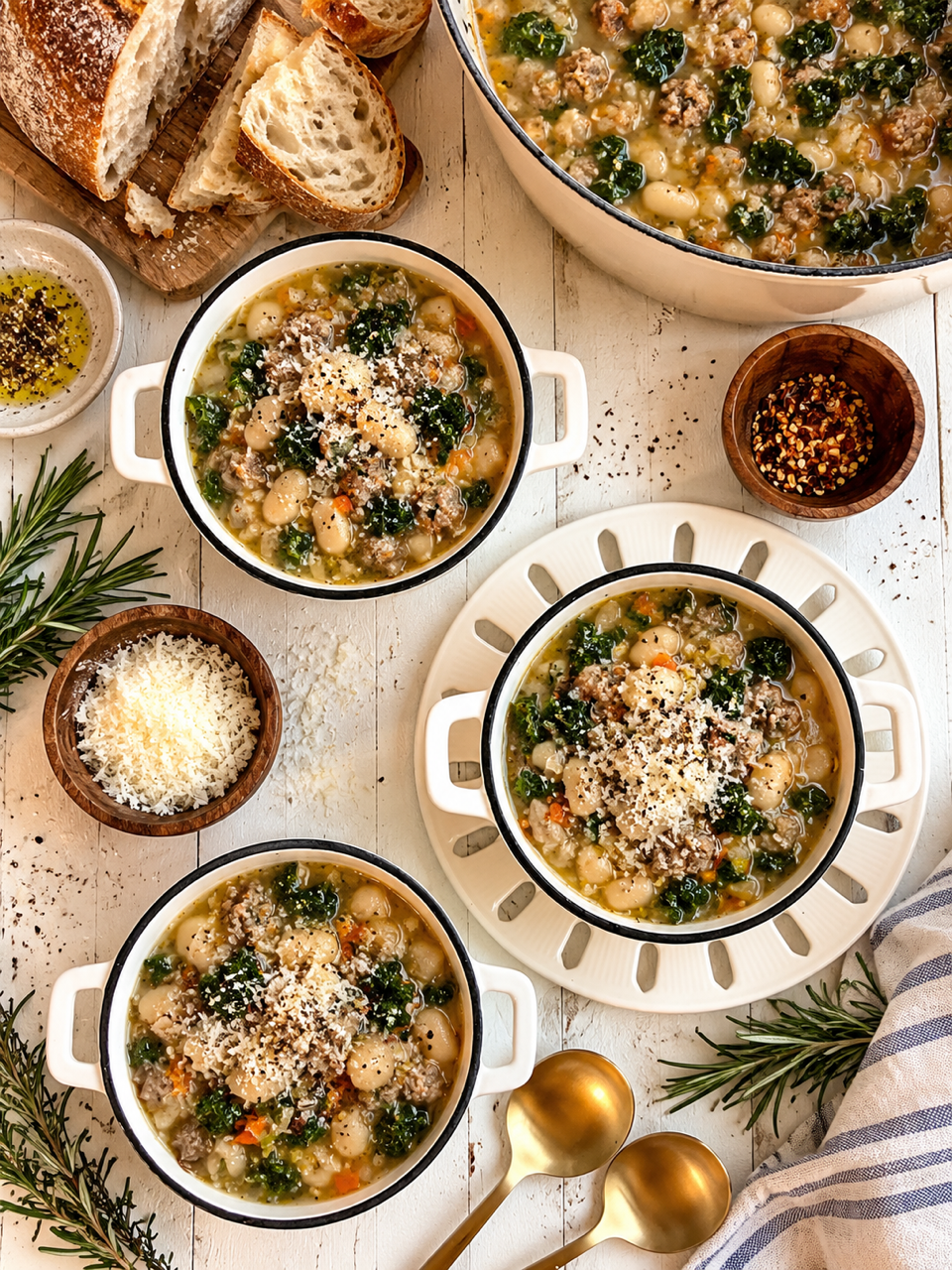
White Bean, Sausage & Kale Soup
Serves 6
INGREDIENTS
1 tablespoon extra-virgin olive oil
1 pound hot Italian sausage or mild Italian sausage, casings removed
1 large yellow onion, chopped, about 2 cups
2 medium carrots, diced, about 2 cups
5 garlic cloves, minced
2 tablespoons finely chopped fresh rosemary, plus more for serving
½ teaspoon fennel seeds, lightly crushed
2 to 2½ tablespoons tomato paste
¾ cup dry white wine
2 (15-ounce) cans cannellini beans, rinsed and drained
4 cups chicken or vegetable stock, preferably homemade
2 teaspoons Better Than Bouillon Roasted Chicken Base or Vegetable Base, encouraged if not using homemade stock
1 Parmesan rind
2 bay leaves
½ teaspoon kosher salt, plus more to taste
½ teaspoon freshly ground black pepper, plus more for serving
1 bunch lacinato kale, about 4 cups, chopped into bite-size pieces
½ cup freshly grated Parmesan, plus more for serving
Zest and juice of ½ lemon, plus more lemon juice if needed
INSTRUCTIONS
Stove Top Method
- Heat olive oil in a large Dutch oven over medium-high heat. Add sausage and cook, breaking it into bite-size pieces, until well browned and cooked through, 6 to 8 minutes. Transfer sausage to a plate with a slotted spoon, leaving rendered fat in pot.
- Reduce heat to medium. Add onion and carrots and cook, stirring occasionally, until softened and onion begins to turn golden, 8 to 10 minutes.
- Add garlic, rosemary, and fennel seeds and cook, stirring, until fragrant, about 1 minute.
- Stir in tomato paste and cook for 2 to 3 minutes, stirring frequently, until paste darkens to a deep brick red and begins to caramelize on bottom of pot.
- Pour in wine, scraping up browned bits from bottom of pot. Simmer until wine has reduced by about half, 3 to 4 minutes.
- Return sausage to pot. Add cannellini beans, stock, Better Than Bouillon if using, Parmesan rind, bay leaves, salt, and black pepper. Bring to a boil, then reduce heat and simmer uncovered for 20 to 25 minutes, allowing broth to reduce slightly and flavors to concentrate.
- Add kale and simmer until tender, about 5 minutes. Remove and discard Parmesan rind and bay leaves.
- Stir in Parmesan, lemon zest, and juice of ½ lemon. Taste before adding more lemon juice, salt, or pepper. Lemon should brighten soup and balance richness of sausage without making broth taste overtly lemony.
- Ladle into bowls and finish with additional Parmesan, cracked black pepper, and a little fresh rosemary.
Slow Cooker Method
- Heat olive oil in a large skillet over medium-high heat. Add sausage and cook, breaking it into bite-size pieces, until well browned and cooked through, 6 to 8 minutes. Transfer sausage to a 6-quart slow cooker, leaving rendered fat in skillet.
- Reduce heat to medium. Add onion and carrots and cook until softened, 7 to 8 minutes. Add garlic, rosemary, and fennel seeds and cook until fragrant, about 1 minute.
- Stir in tomato paste and cook for 2 to 3 minutes, until darkened. Pour in wine, scraping up browned bits from bottom of skillet, and simmer until reduced by about half, 3 to 4 minutes. Transfer mixture to slow cooker.
- Add cannellini beans, chicken or vegetable stock, Better Than Bouillon if using, Parmesan rind, bay leaves, salt, and black pepper. Cover and cook on LOW for 5 to 6 hours or HIGH for 2½ to 3 hours.
- Stir in kale during final 20 to 30 minutes of cooking, or until tender.
- Remove and discard Parmesan rind and bay leaves. Stir in Parmesan, lemon zest, and juice of ½ lemon. Taste and add more lemon juice, salt, or black pepper if needed.
- Ladle into bowls and finish with additional Parmesan, cracked black pepper, and fresh rosemary.
Storage
Refrigerate: Cool completely, then store in an airtight container for up to 4 days.
Freeze: Freeze in airtight containers for up to 3 months. Thaw overnight in refrigerator before reheating.
Reheat: Warm gently on stovetop over medium-low heat, adding a splash of chicken or vegetable stock if needed.

