
Whenever I Call You Friend
Some friendships don’t end. You just realize one day that you’ve been remembering them longer than you’ve been living them.
For most of my life, I gave longevity more authority than it deserved. There is something persuasive about people who can remember your maiden name, your first boyfriend, your unfortunate haircuts, and the equally questionable choices you would now deny under oath. All those accumulated years can make a relationship feel permanent simply because so much evidence exists that it once mattered.
Time proves something happened. It doesn’t necessarily tell you what is happening now.
I have been thinking about that lately because I quietly removed myself from a group chat with people I had known since high school. It was never a daily conversation. Months could pass before somebody went to see a band we once listened to, ran into someone from those years, or a birthday came around. Then the phones would start pinging and we would gather briefly around a life we had shared four decades earlier.
I was eighteen then. I am 58 now. There is enough distance between those two women that I don’t remember much about the first one. I know she mattered because she got me here, but I have no particular desire to keep reporting for duty as her.
I don’t want to be loved only in the tense in which someone first knew me.
What interests me now is everything that couldn’t possibly have been known about us then. Who did you become when nobody from high school was watching? Where did life take you that you never intended to go? What are you doing with the person all those years produced? I don’t need another story about who we were. I want to know what you’re doing with who you are.
I want the friend who remembers my old stories but asks me for a new one. And I want to be that friend in return.
Which raises a question we are often afraid to ask about people we have known for a very long time: if the past weren’t introducing us, would we become friends today?
That may sound harsh, but I actually think it is an extraordinarily compassionate question. It doesn’t ask us to disown the people we once were or diminish what someone gave us. It simply separates gratitude from obligation.
You are allowed to miss someone and still not want them back.
Years ago, a friend told me that people come into our lives for a reason, a season, or a lifetime. More than forty years later, she proved herself correct. Maybe that was the point.
For years, I thought the wisdom was in figuring out which category everyone else occupied. Life has complicated that considerably. I have been somebody’s reason. I have almost certainly been temporary in someone else’s life. There may be people who are grateful I arrived and equally certain it was right for me to go.
We are not always the person doing the outgrowing. Sometimes we are the thing being outgrown.
There is mercy in accepting that. It means I don’t have to turn every departure into a referendum on my worth, and I don’t have to make somebody else wrong before I am allowed to leave. We spend a great deal of time trying to determine who failed whom when sometimes two people simply reach the end of what they have to give each other.
Some endings come with wreckage. Trust gets broken. Something is said that cannot be unsaid. Forgiveness may eventually arrive, although forgiveness and reunion are not the same promise. Other relationships reach their conclusion without anything dramatic enough to name.
I wanted mine to be that kind of exit.
I waited until the group had been still for months. Leaving during an active exchange would have turned an ordinary decision into an announcement, and I had nothing to announce. One afternoon, I quietly removed myself from the chat.
Not every goodbye needs a slammed door. Sometimes leaving gently is the last kindness you give a friendship.
I wish we taught our daughters that sooner. We teach girls to make the effort, remember the birthday, forgive, include, stay in touch. Those are worthy instructions, but somewhere among them should be permission to recognize when something has run its course. You can share a beautiful past with someone without having enough of a present to build a future.
A friendship can be complete without being a failure.
There is another piece of this I understand differently now, and it has less to do with who leaves than with who stays. I once thought hardship was the great test of friendship. Certainly, there is no substitute for the person who appears when everything collapses. But happiness reveals people too.
Sorrow asks for sympathy. Success requires a different generosity.
You should never have to make your happiness smaller before handing it to a friend.
A real friend can hear your good news without treating it as information about her own life. She doesn’t begin doing arithmetic or need your accomplishment reduced so there is more room for hers. She wants the whole story. She remembers how hard you worked for it and is delighted that the thing you wanted finally found you.
I know who I call first now. But there is a responsibility attached to knowing what I want from friendship: I have to offer it.
It is remarkably easy to read something about relationships and mentally assign every sentence to somebody who disappointed us. Eventually, we have to consider what it feels like to be our friend.
The goal isn’t only to find better friends. It is to become one.
When her opportunity arrives before yours, celebrate her. If she becomes more successful, don’t ask her to return to a version of herself that made you more comfortable. When she changes her mind, find out why. When life takes her somewhere you have never been, remain interested enough to learn the way.
Friendship should be one of the few places where becoming more yourself never costs you your seat.
That, more than longevity, is what I recognize in the relationships I treasure now. A lifetime friend isn’t necessarily the person who has accumulated the most years beside you. She is the person willing to keep knowing you after you change. She can remember where you came from without continually sending you back there, and she is genuinely interested in what you haven’t done yet.
I want the friend who can look backward with me without needing us to live there.
And I want to be her.
Love what was good. Forgive what needs forgiving. Let the people who no longer belong in your present remain part of your past without rewriting either one. There is no prize for keeping every person who has ever mattered, and no shame in discovering that sometimes you were the one somebody else needed to release.
Because after all these years, I think I finally understand what makes someone a lifetime friend.
She doesn’t just remember who you were. She keeps showing up to meet who you become.
Hungarian Mushroom Soup
Serves 6
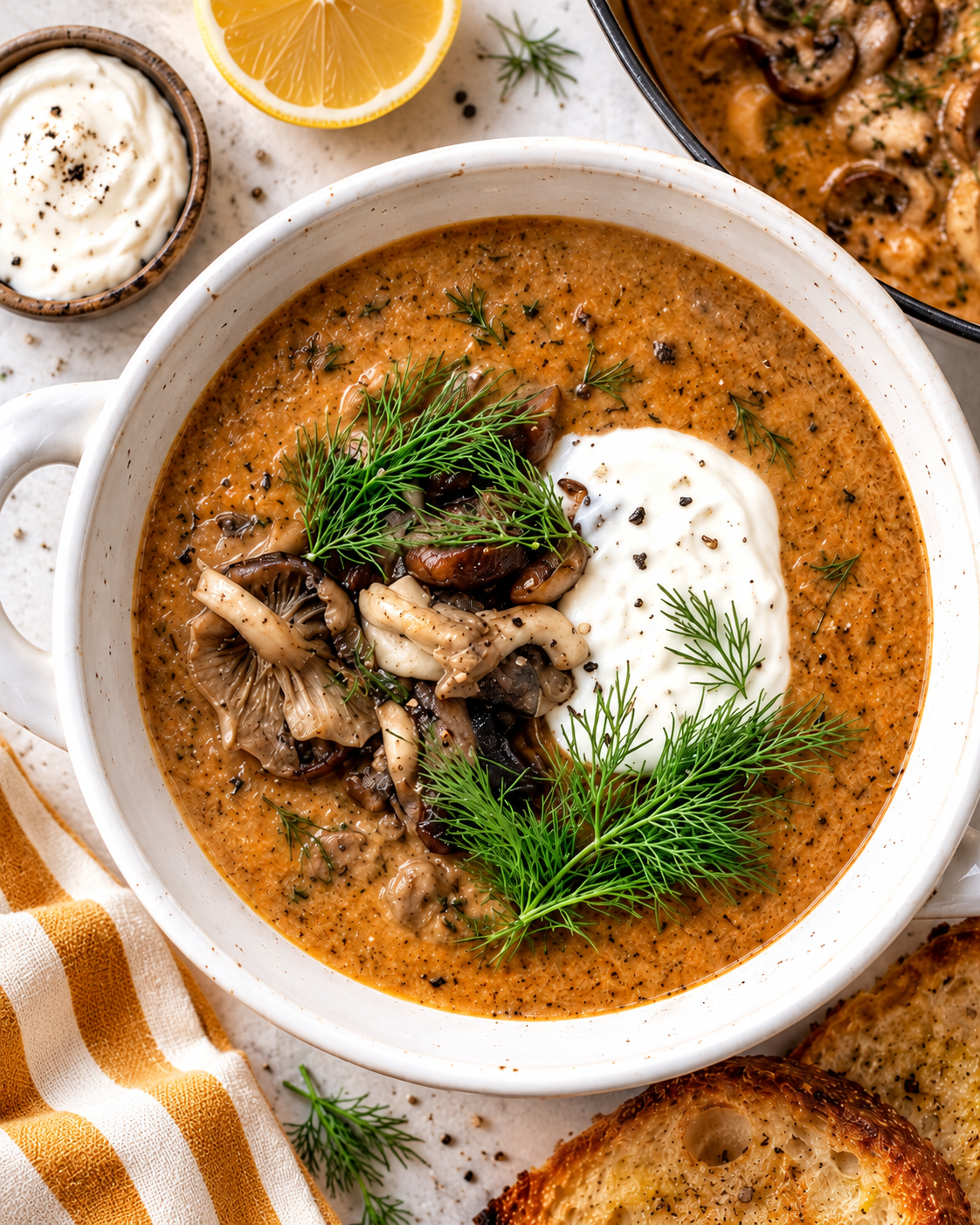
Hungarian mushroom soup is what happens when cream of mushroom grows up and develops considerably better taste. Two pounds of meaty cremini, baby bella, and shiitake mushrooms give the broth its deep, earthy backbone, while authentic Hungarian sweet paprika, dill, thyme, white wine, and a touch of soy sauce build warmth and savory depth. Mushroom powder intensifies all that woodsy richness without announcing itself, and lemon zest keeps the creaminess from becoming heavy. Finished with tangy crème fraîche and a generous scattering of fresh dill, this is a velvety, paprika-blushed bowl with considerably more personality than its humble name suggests.
Ingredients
½ cup unsalted butter, divided
2 pounds mixed mushrooms, such as cremini, baby bella, and shiitake, trimmed and sliced
2 yellow onions, finely chopped, about 3 cups
1 tablespoon Hungarian sweet paprika
3 teaspoons dried dill
1 tablespoon fresh thyme leaves or 1½ teaspoon dried thyme
1 teaspoon mushroom powder
1 teaspoon kosher salt, plus more to taste
¾ teaspoon freshly ground black pepper, plus more to taste
5 tablespoons all-purpose flour
1 cup dry white wine
4 cups low-sodium chicken or vegetable stock
3 to 4 tablespoons soy sauce, to taste *
1 bay leaf
Zest of 1 large lemon
1½ cups half-and-half
½ cup crème fraîche, plus more for serving
1 tablespoon fresh lemon juice, plus more to taste
Chopped fresh dill, for serving
Instructions
- Melt 3 tablespoons butter in a large Dutch oven over medium-high heat. Add half mushrooms in an even layer and cook, stirring occasionally, until they release their moisture and develop deep golden-brown edges, 6 to 8 minutes. Transfer to a bowl.
- Melt 3 tablespoons butter in pot. Add remaining mushrooms and cook until deeply browned, 6 to 8 minutes. Return first batch of mushrooms to pot. Reduce heat to medium, add remaining 2 tablespoons butter and onions, and cook, stirring occasionally, until onions are very soft and beginning to turn golden, 8 to 10 minutes.
- Add paprika, dried dill, thyme, mushroom powder, salt, and black pepper. Cook, stirring constantly, for about 30 seconds, just until fragrant. Do not allow paprika to scorch.
- Sprinkle flour evenly over mushroom mixture and cook, stirring constantly, for 2 minutes, until flour has absorbed butter and thoroughly coated mushrooms. Gradually pour in wine, stirring and scraping bottom of pot to release browned bits. Simmer until wine has reduced by about half, 3 to 5 minutes.
- Gradually stir in stock. *Stir in 3 tablespoons soy sauce. Taste near the end of cooking and add the remaining 1 tablespoon if more savory depth is needed. Add bay leaf, and lemon zest. Bring to a gentle simmer and cook, uncovered, for 15 to 20 minutes, stirring occasionally, until soup has thickened slightly and flavors have developed.
- Remove and discard bay leaf. Reduce heat to low and gradually stir in half-and-half. Cook just until heated through, 3 to 5 minutes. Do not boil.
- Remove pot from heat and let bubbling subside. Place crème fraîche in a small bowl and gradually whisk in about ½ cup hot broth. Stir mixture back into soup until completely incorporated. Add 1 tablespoon lemon juice. Taste and add more salt, black pepper, or lemon juice as needed.
- Ladle into bowls and finish with a spoonful of crème fraîche, chopped fresh dill, and freshly cracked black pepper.
Storage
Refrigerate: Store in an airtight container for up to 4 days.
Freeze: Freeze without garnish for up to 2 months. Thaw overnight in refrigerator. Texture may separate slightly after freezing.
Reheat: Warm gently over medium-low heat, stirring often. Add a splash of stock or half-and-half if needed to loosen. Do not boil.

